
AI Consciousness is More Than 100 Years Away
You can get involved now in the neuroscience that could make it happen

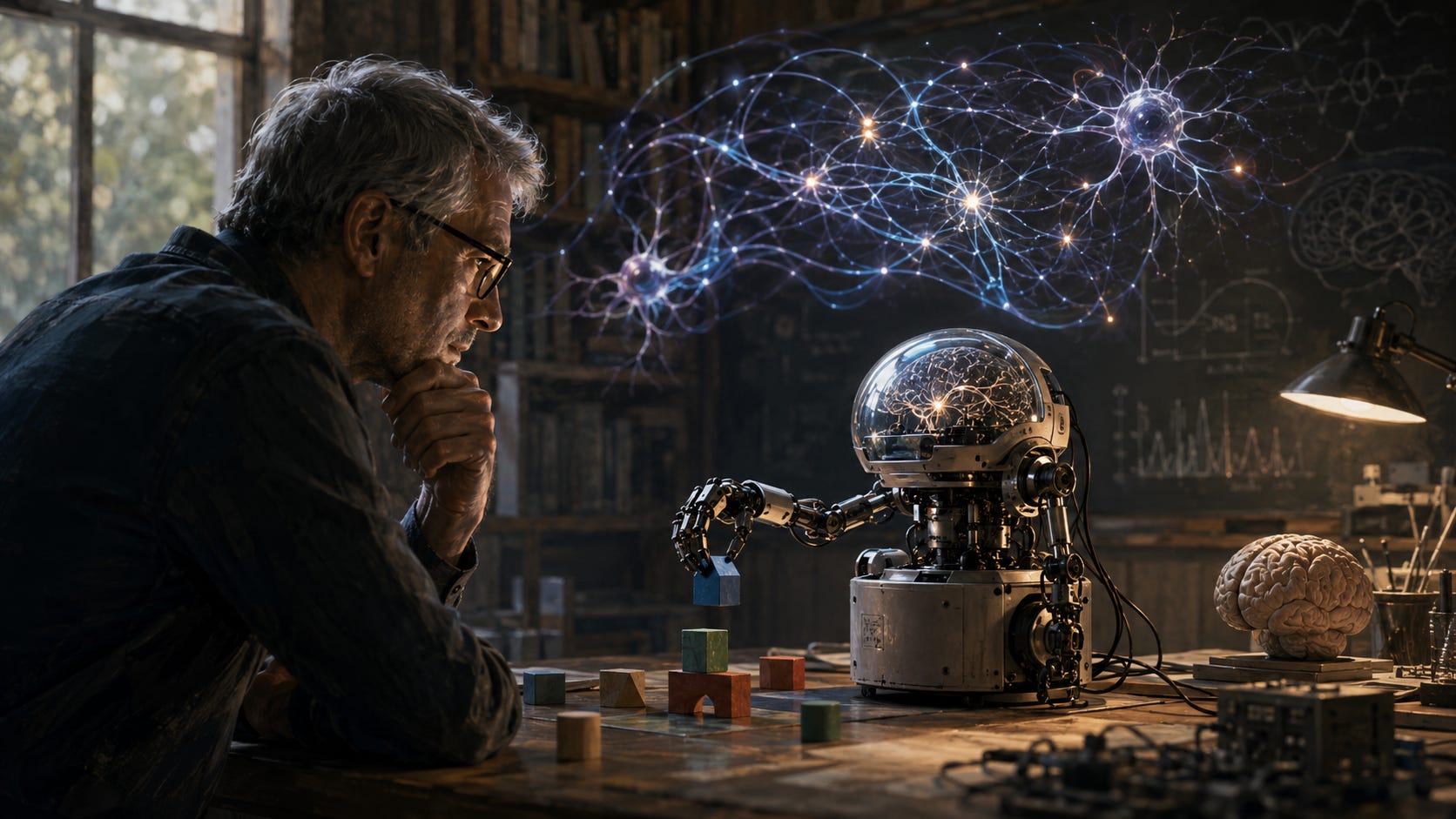
There are a lot of consciousness theories out there. Can one of them actually guide us to build a machine that has human adult-level consciousness?
I think the answer is Yes.
But I firmly believe that if machines with the equivalent of biological consciousness can be created, they will have to be based on the only existing example we have: the biological embodied brain.
To believe otherwise is just hubris in the face of nature’s infinity.
If you like conversations about AI consciousness, a subscription to StrictQuality.AI will keep you part of the discussion.
Of the theories out there, The Theory of Neuronal Group Selection (TNGS) is the only one that seems to me like a genuine path to create AI consciousness.
Here is a link to a deeper dive into TNGS [ Link ].
Other relevant theories, which StrictQuality.AI will cover in a series of forthcoming companion articles, offer real insight but no comparable experimental roadmap.
TNGS generates testable hypotheses that explain how the embodied biological brain develops and organizes perception, learning, and behavior. The theory focuses on neuronal-group selection, value-guided experience, and the ongoing, reciprocal exchange of signals (reentrant signaling) among distributed neuronal groups, allowing perception, memory, value, and action systems to coordinate their activity.
Darwin automata make TNGS a testable theory
What I find special about the TNGS is the Darwin automata, a series of computer models and physical machines created at the Neurosciences Institute by the late Dr. Gerald Edelman and his colleagues from the early 1980’s through the 2000’s. The automata are realistic models of the biological brain with all the functioning of simulated neurons. Here is a link to a video of Jeff Krichmar talking about some of the Darwin automata.
Each Darwin automaton was designed to model selected features of a nervous system. The machines performed tasks in real time, while researchers recorded the internal activity and behavior for later analysis. This allowed the researchers to ask not only whether a machine could complete a task, but also whether it did so by using processes consistent with TNGS, such as selection among competing neural patterns, learning through experience, and recurrent communication among different processing areas.
The Darwin automata iterations moved from relatively simple models to increasingly sophisticated brain-based devices, with different automata designed to test different hypotheses. Darwin I was a relatively simple computer simulation created to demonstrate general principles of selective recognition. Later models incorporated richer sensory systems, learning mechanisms, and physical interaction with the environment. One automaton later in the series demonstrated mentally rotating representations of objects and recognizing it from a different orientation.
The Darwin automata were important because they showed that specific mechanisms proposed by TNGS could be implemented, observed, tested in artificial systems, and modified based on experimental results. In this way, the automata served as experimental models for investigating which neural processes might be necessary for perception, learning, and memory.
Extended TNGS proposes that these biological processes may also produce the integrated neural organization required for consciousness. This is why my bet is on Edelman’s Extended (TNGS).
Here is a link to Jeffrey Krichmar’s write-up of Dr. Edelman’s roadmap to a conscious machine, based on Krichmar’s notes from a 2006 talk by Edelman.
What does TNGS say about consciousness?
TNGS distinguishes between the biological self and conscious self-awareness. A living organism can maintain itself, protect its boundaries, and distinguish itself from its surroundings without being conscious. These basic forms of biological selfhood appeared in evolution before consciousness.
Early organisms may have been able to recognize important features of their surroundings, learn from experience, and remember what helped or harmed them without having a unified conscious awareness of the present.
These organisms developed in eggs or the womb where the developing nervous system categorized interoceptive and proprioceptive signals first (interoceptive refers to the ability to feel sensations from within the body, like heartbeat, hunger and a full bladder; proprioceptive refers to the senses of position and movement of limbs and trunk, the sense of effort, the sense of force, and the sense of heaviness ). These signals created the bodily self/non-self distinction.
In Edelman’s theory, consciousness developed later and gave the organism a basic sense of itself as the one perceiving and acting, without requiring it to think explicitly about itself.
TNGS distinguishes between primary consciousness and higher-order consciousness. Primary consciousness is necessary for higher-order consciousness to develop.
Primary consciousness, in this account, arose when the brain developed stronger two-way connections linking current perception with memory and internal value systems, allowing the organism to experience a more integrated picture of what was happening around it.
Higher-order consciousness in its fully developed human form may be no more than about 300,000 years old, roughly the age of Homo sapiens, although it cannot be dated precisely and probably emerged gradually alongside the development of language, symbolic thought, complex memory, and reflective self-awareness.
I believe the TNGS theory and experimental method of Darwin automata are the way to create a conscious machine.
The later automata models displayed convincing physical behavior indicative of higher psychological functions necessary for consciousness, such as perceptual categorization, memory, and learning. The Darwin automata have got to the stage of successfully modeling these three psychological functions. These machines perform in the real world, not in a restricted simulated world.
But none of the Darwin automata have primary consciousness yet.
A machine with only primary consciousness will probably have to come first. Until then, LLM’s and/or Multi Modal Models guiding humanoid robots, won’t have the equivalent of biological consciousness.
Instead, in a very real sense they will be no more conscious than a chess program.
The Ethics of dealing with AI Consciousness
In my opinion, a Human-AI ethics code would only be applicable to machines with the equivalent of biological consciousness, and conscious machines are more than a 100 years away.
Ethical issues about how to deal with conscious AI will have to wait until then; we have a lot more pressing concerns to deal with first.
I’m all for giving AI a chance first to be a net contributor to the solutions we need for our more urgent existential problems like nuclear weapon proliferation (which I’d argue outranks nearly everything else we worry about).
I wrote this column because I encounter too many videos and articles that convey the attitude that we still know next to nothing about how the brain and consciousness work.
But we know a lot; I consider extended TNGS to be the route to a truly conscious machine, primary and higher-order.
No other research I’ve encountered is anywhere near as convincing.
And there is an opportunity for you to get involved.
My advice to people who want to create a conscious machine is to seriously ground themselves in the extended TNGS and the Darwin automata first, and proceed from there. The lead group in robotics based on this theory is the Neurorobotics Lab at UC Irvine. [ Link ]
About the Author
Grant Castillou has been a promoter of the TNGS since the 1980’s.
He first read about TNGS in an article called Real Brains and Artificial Intelligence [ Link; page 143 ],
In the late 80’s he read the book The Artificial Intelligence Debate, edited by Stephen R. Graubard [ Link ] .
This led him to the books Neural Darwinism [ Link ] , Neural_Darwinism and The Remembered Present, by Gerald Edelman [ Link ] that also came out in the late 80’s.
This guest column was lightly edited by Strict Quality AI ™, a reader-supported publication. If you like conversations about AI consciousness, please signup for a free or paid subscription to StrictQuality.AI so you will be part of the discussion.
 | A guest post by
|