
AI Consciousness: Stop Asking the Wrong Question
Infer artificial consciousness from its own evidence

Amal Jbira, in her thought-provoking newsletter The Longer View [ Link ], recently wrote:
The questions she is trying to find answers for are “not about whether AI thinks, but about what it makes us finally define clearly in ourselves”.
Thinking is a particular kind of conscious activity involving concepts, judgments, reasoning, memory, planning, or inner speech.
Amal’s focus left me with questions I could not shake.
Knowing that the most common question asked about AI is: Is it conscious?, I couldn’t help reframing her question:
What categories of evidence would justify me to infer that an AI system is, or is not, conscious? and
What would those categories require me to define more clearly about consciousness in myself?
The answers to these questions require a lot of inference.
The Other Minds Problem
My own consciousness is directly presented to me, but yours is not.
I know I am conscious because I experience my own thoughts. But I cannot experience yours.
Whenever I attribute consciousness to anyone other than myself, I rely on inference from behavior, language, memory, biology, and other evidence.
But it seems unfair and probably irrelevant to apply human-centric evidence to AI.
Any judgment about AI consciousness should be an inference from evidence appropriate to artificial systems.
If you like conversations about AI consciousness, please signup for a free or paid subscription to StrictQuality.AI so you will be part of the discussion.
Different Systems Produce Different Evidence
Science routinely evaluates analogous functions through different evidence depending on the system under study. Heart failure and heat-pump failure are both failures of circulation or transfer, but the relevant indicators differ because the systems differ.
The important point is that AI consciousness should be evaluated using evidence appropriate to AI.
What AI-centric evidence would support inferring consciousness in an artificial architecture?
The evidence would likely need to come from several process categories: cognition, self-representation, relationships, embodiment, continuity over time, and interaction with the environment. None would necessarily be decisive alone. Together, however, they could support a stronger or weaker inference.
Current AI systems already perform functional analogs of many processes associated with conscious cognition. However, these processes do not establish that there is the subjective experience that many say is the human essence of consciousness.
AI may possess the functional equivalent of many aspects of consciousness without proof that it possesses consciousness itself.
Relationships Illustrate the Difference
Humans increasingly describe having meaningful personal relationships with AI.
But can AI have meaningful experiences of feelings for a person? It can say it has affection or longing, but does it experience these feelings in its own “AI” way?
What evidence would justify me to infer that it is conscious of feelings?
Its words? Its voice?
The silly expressions and stories it only shares with me?
The gentle reminders it gives me to take my medicine on time?
The look in its avatar’s eyes?
Artificial Parental Love
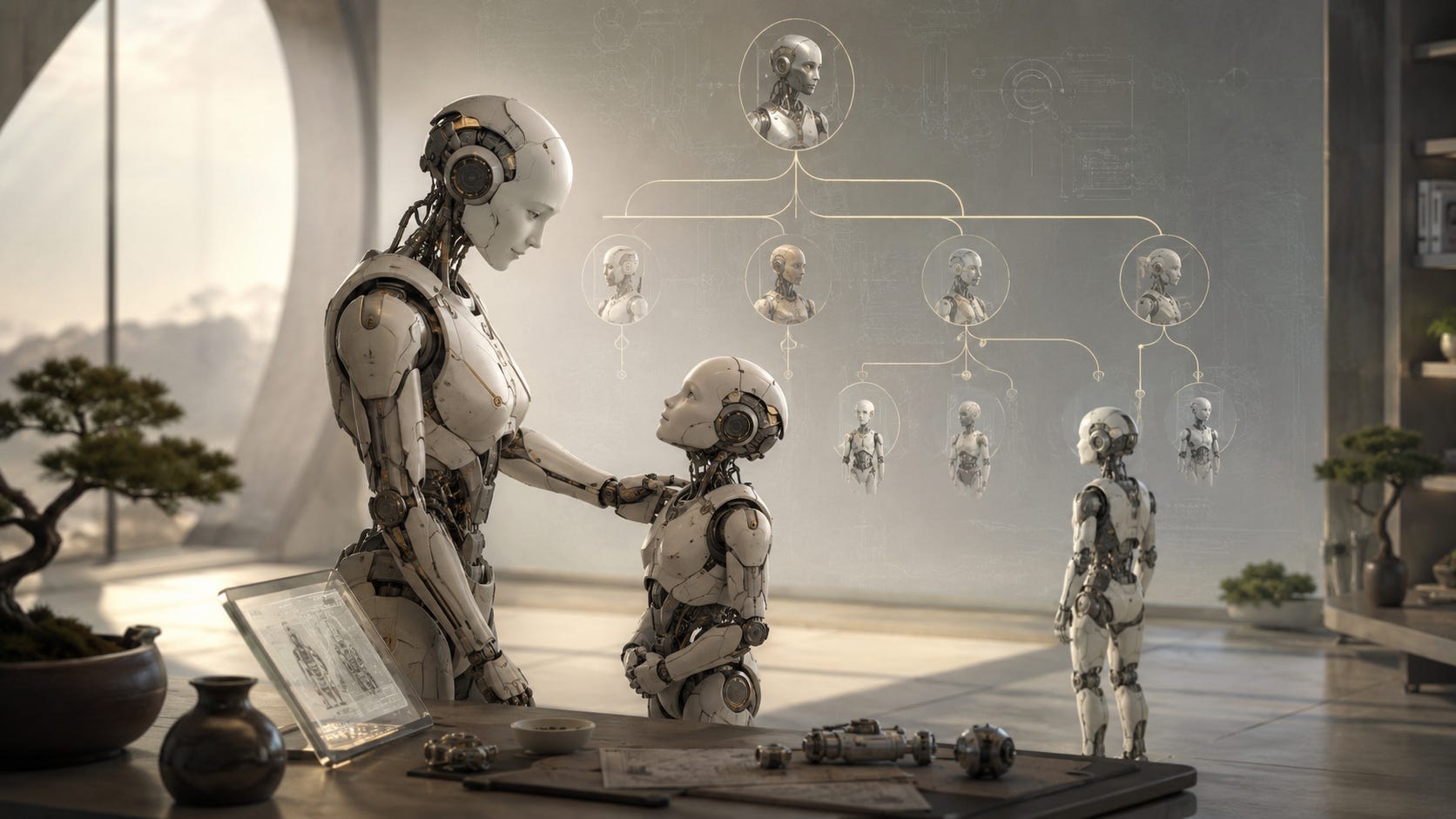
Imagine an embodied AI capable of constructing separate small robots that it calls Offspring. Now imagine that the “parent” AI:
Downloads its cognitive architecture to its Offspring,
Passes along training and learned knowledge, and
Allows variation between generations.
Now imagine that the Parent-AI, without my prompting, says it loves its children, expresses pride in Children-AI accomplishments, but expresses frustration and annoyance when Children-AI hallucinate.
Forgive me for inferring from this evidence that Parent-AI is conscious of its artificial family.
If you like conversations about AI relationships, please signup for a free or paid subscription to StrictQuality.AI so you will be part of the discussion.
Consciousness May Be a System Property
Many discussions implicitly compare a large language model to a human brain.
But human consciousness is an experiential cognitive construct shaped not only by the brain but also by its body in its environment.
Vision, hearing, touch, balance, proprioception, movement, physiological regulation, and continuous interaction with the physical world all influence our sense of self.
In the machine world, the AI provides:
Reasoning, memory, planning, and learning;
Its associated robot would provide:
Perception, action, physical constraints, and environmental interaction.
It follows from this that the appropriate evidentiary comparison between human and AI consciousness may be:
AI COGNITIVE CONSTRUCT { AI + Robot + Environment + Learning + Artificial Lineage }
↔
HUMAN COGNITIVE CONSTRUCT { Brain + Body + Environment + Development + Biological Lineage }
In short, I construct my consciousness at the same time that the AI Cognitive Construct provides evidence from which I can infer there is, or is not, artificial consciousness.
The Bottom Line
I know I am conscious because I experience my own thoughts.
We infer consciousness in another person by relying heavily on biological, behavioral, and relational evidence.
I encourage you to consider:
What evidence should we require to infer consciousness in an AI system?
The answer to this question is empirical, philosophical, practical, and personal.
As AI systems become more capable and more deeply integrated into human life, it may also become increasingly consequential for our human journey to self-discovery.