
AI Consulting Industry Enjoys Boom. But is a Bust Coming?
Consultants large and small working to close the AI Implementation Gap.

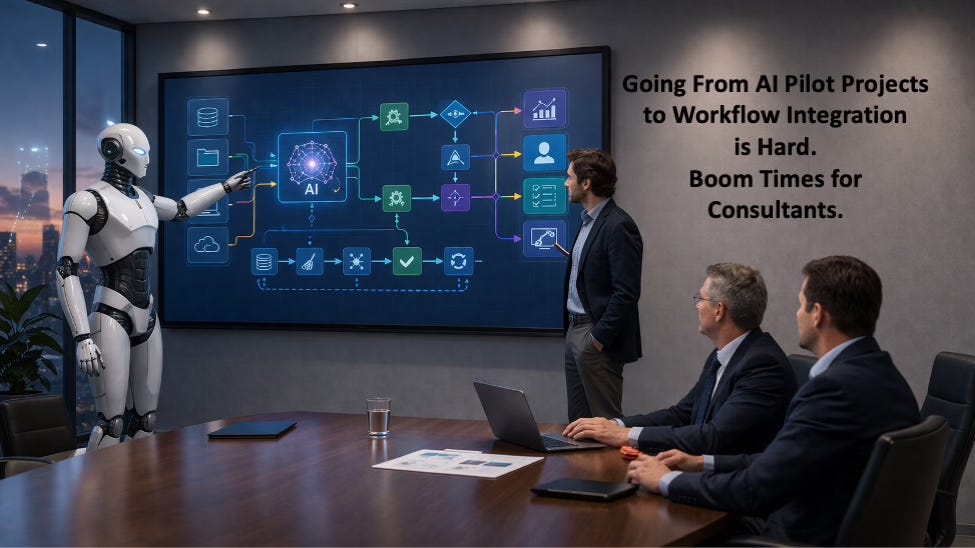
Companies often don’t have the bandwidth to pilot AI tools and integrate the successful ones into operational workflows.
The Wall Street Journal reports that one of the primary obstacles for large corporations and complex organizations is a deficit in internal technical expertise. Their challenge is compounded because corporate data typically is trapped in old, “siloed” systems that don’t talk to each other.
The result is an “AI Implementation Gap” from the pilot stage to the workflow integration stage.
To bridge this gap, organizations are hiring external consultants to clean legacy data and architect the necessary technical scaffolding.
This trend is most pronounced in large-scale enterprises with fragmented technology infrastructure. Smaller businesses generally avoid these high-costs by waiting for “turnkey” AI features to be integrated into their existing software suites.
Getting large clients over the “AI Implementation Gap” is resulting in a surge of revenue for consulting giants. For example, Accenture had $2.2 billion in new AI bookings in the most recent quarter reported.
There are some ironies here:·
The money that is supposed to be “saved” by AI automation is instead being paid out in consulting fees.
The consultants are being paid to build their own replacement and reaching record revenues in the process.
Strategic Implications
The temporary AI gold rush that the global consulting firms are enjoying now masks a structural threat to their traditional pyramid hierarchy of billable hours.
The “Hollowed Out” Pyramid of Billable Hours:
For decades, these firms generated massive profits by billing clients for thousands of human hours spent by junior associates on manual research, data entry, and slide production. But as AI automates these entry-level tasks in seconds, the ability to charge for that “volume of labor” disappears.
This dynamic forces firms to pivot away from selling “human time” and shift toward a senior-heavy model focused on high-value architecture and change management.
The paradox and structural shift in the business model of large dominant consulting firms is likely to have implications for the prospects of small independent AI consultants.
For the small independent consultant, this shift creates a unique opening to capture the AI Implementation Gap through performance-based pricing and specialized architecture.
To determine if the boom time for high-cost consultants is permanent or a temporary “installation phase,” monitor signals such as trends in Agentic AI Infrastructure, corporate hiring for “Internal “AI Centers of Excellence”, and a shift to performance-based pricing models.
If you want more analysis like this, please subscribe. Free or Paid plans are available.
Free subscribers get:
Email notification and access to StrictQuality.AI Posts and Notes.
Paid subscribers get access to full Posts. For this article:
A deep dive into Trends and Opportunities for Small Independent Consultants.
Four Signals to Watch for to determine if the boom time for high-cost consultants is permanent or a temporary “AI installation phase”.
Access to Comments and Archives.
Keep reading with a 7-day free trial
Subscribe to Strict Quality AI ™ to keep reading this post and get 7 days of free access to the full post archives.