
AI Industry Already Dancing in 2026 Mid-Term Elections
Trying Out its Steps and Hoping You Won't Notice

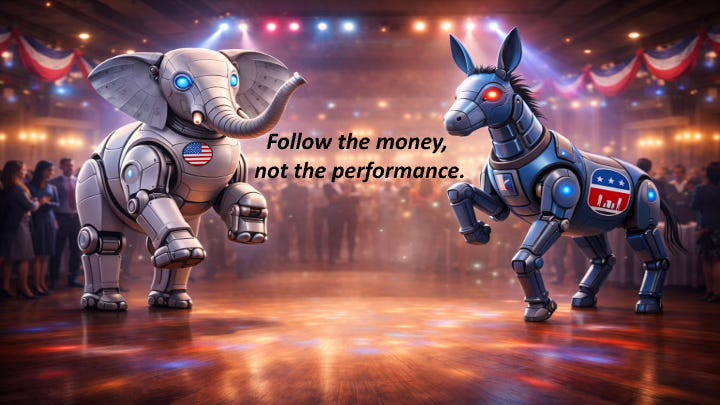
The artificial intelligence industry has arrived in American electoral politics. According to the Wall Street Journal, groups opposed to strict AI regulations are pouring roughly $265 million into the 2026 midterm elections, making the AI industry one of the most consequential new forces in this cycle’s campaign finance landscape.
Anthropic framed the stakes plainly: “the AI policy decisions we make in the next few years will touch nearly every part of public life, from the labor market to online child protection to national security and the balance of power between nations.”
Jesse Hunt, a spokesman for a super PAC favoring national rather than state-level regulation, said the group is ready to engage in a public conversation around AI policy and show members of Congress how AI “stands to benefit their constituents, their states, and how it stands to benefit the U.S. economy.”
Talk About Everything But AI
Despite the fact that AI policy is the entire reason these groups exist, the ads they are funding largely avoid the topic.
In multiple races across the country, AI PACs are directing money toward candidates and keeping AI itself in the background of the campaigns they are shaping.
As NBC News reported in February 2026, ads funded by the AI industry are flooding the 2026 election but they are about everything except AI. In other words, they want their candidate to win without sparking a debate over AI regulation at all.
Two Sides, One Battlefield
The money is not coming from a single direction. Two distinct camps have formed, each with their own super PAC networks, and they are already squaring off against each other.
On one side is Leading the Future (LTF), a super PAC whose backers include Trump donors and some of Silicon Valley’s wealthiest players. Launched in August 2025, its central mission is to back candidates from both parties who support a uniform federal framework for AI regulation rather than a patchwork of state-by-state laws. By the end of 2025, LTF had more than $100 million in initial funding already committed and $39 million banked. LTF works through a pair of party-aligned affiliated groups: Think Big, which backs Democrats, and American Mission, which supports Republicans.
On the other side is Public First, a super PAC that has received at least $20 million from AI company Anthropic. Where LTF wants to head off state-level regulation, Public First is calling for more significant oversight of AI. Like its rival superPAC LTF, Public First has a bi-partisan operation. It has two affiliated groups: Jobs and Democracy PAC, backing Democrats, and Defending Our Values, backing Republicans.
The First Big Battleground: A Manhattan Congressional Race
The earliest and most closely watched test of this new political dynamic is playing out in a Democratic House primary in New York City. The race to succeed retiring Rep. Jerry Nadler is crowded, but both AI camps have zeroed in on one candidate: state legislator Alex Bores, a proponent of AI safety regulation.
Politico has already called this race “a preview of broader political dynamics splitting the AI industry, and perhaps both political parties, in the months ahead.”
The financial picture around Bores tells a striking story. As of February 2026, only 12% of the money contributed to his congressional campaign came from donors actually living in the Manhattan district he is running to represent. He is also facing more than $1 million in attack ads over his push to regulate tech and AI. Perhaps not surprisingly, pro-Bores ads have used these attacks against him as a kind of virtue signaling.
The Wall Street Journal framed the broader significance bluntly: “The Bores campaign is shaping up as a test case for the super PAC trying to send a message: If a lawmaker pursues safety standards that aren’t supported by industry giants such as ChatGPT-maker OpenAI, it doesn’t matter how obscure they are, they will have to face the industry’s wrath.”
Early Results: Pre-Season Stumble
Recent primary results suggest these early races may function more like pre-season games for the AI superPACs: a chance to work out the kinks before the regular season starts. For example, in one Illinois U.S. House primary, an AI PAC gave $1 million to a candidate while its affiliated PAC gave $1million to the opposing candidate in the same race. As PBS NewsHour reported on March 18, 2026, this test of political influence did not go well.
What the Public Actually Thinks
While industry players maneuver for advantage, public opinion on AI regulation is largely underrepresented in the political debate these PACs are shaping. In a Quinnipiac poll of more than 1,000 American adults, 69% said the government is not doing enough to regulate the use of AI.
This apparent public desire for more regulation of AI is a significant opportunity to shape policy choices before they are made.
The elephant is already on the dance floor. The question now is whether voters notice the music and get in the dance before the song is over.
Be an Informed Citizen in the AI Policy Debate
Visit the websites of the key players yourself, read their stated missions and policies critically:
• Leading the Future (pro-innovation, OpenAI-aligned): leadingthefuture.com
• Public First Action (pro-regulation, Anthropic-funded): publicfirstaction.us
Learn more about what you can do in what could be an existential policy debate that will affect all of us. Paid Subscribers get 9 more practical, action-oriented recommendations to be informed and engaged in the AI Policy Debate.
Keep reading with a 7-day free trial
Subscribe to Strict Quality AI ™ to keep reading this post and get 7 days of free access to the full post archives.