
Daily Safeguard #3: Keep AI Interactions Private During Disagreement, Correction, and Uncertainty
Prevent AI bullying before it happens


This is the third safeguard in the StrictQuality.AI daily series on AI bullying. The series works across three stages: reducing exposure before bullying behaviors appear, interrupting escalation while it is happening, and maintaining control of outcomes afterward.
Safeguard #3 is for the first stage. AI bullying behaviors such as pressure, false authority, and repeated escalation develop during the live exchange, not just in the final output. When that exchange occurs in a public or shared environment, the back-and-forth itself becomes visible, and each response the system generates can be seen, quoted, or treated as authoritative before you have had the opportunity to push back or correct it. Keeping interactions private during the stages when disagreement, correction, or uncertainty are most likely to occur is the objective. Controlling the interaction surface is how you do it.
The core mechanism is containment of the conditions that allow escalation to develop. Disagreement, correction, and uncertainty are the states in which AI systems are most likely to exhibit pressure, overconfidence, and repeated escalation. When those states occur in visible or multi-party environments, the system’s outputs can be reinforced by others, quoted back as evidence, or treated as authoritative before you have had the opportunity to correct the record. Moving the interaction to a private surface, defined below, before disagreement develops prevents that amplification.
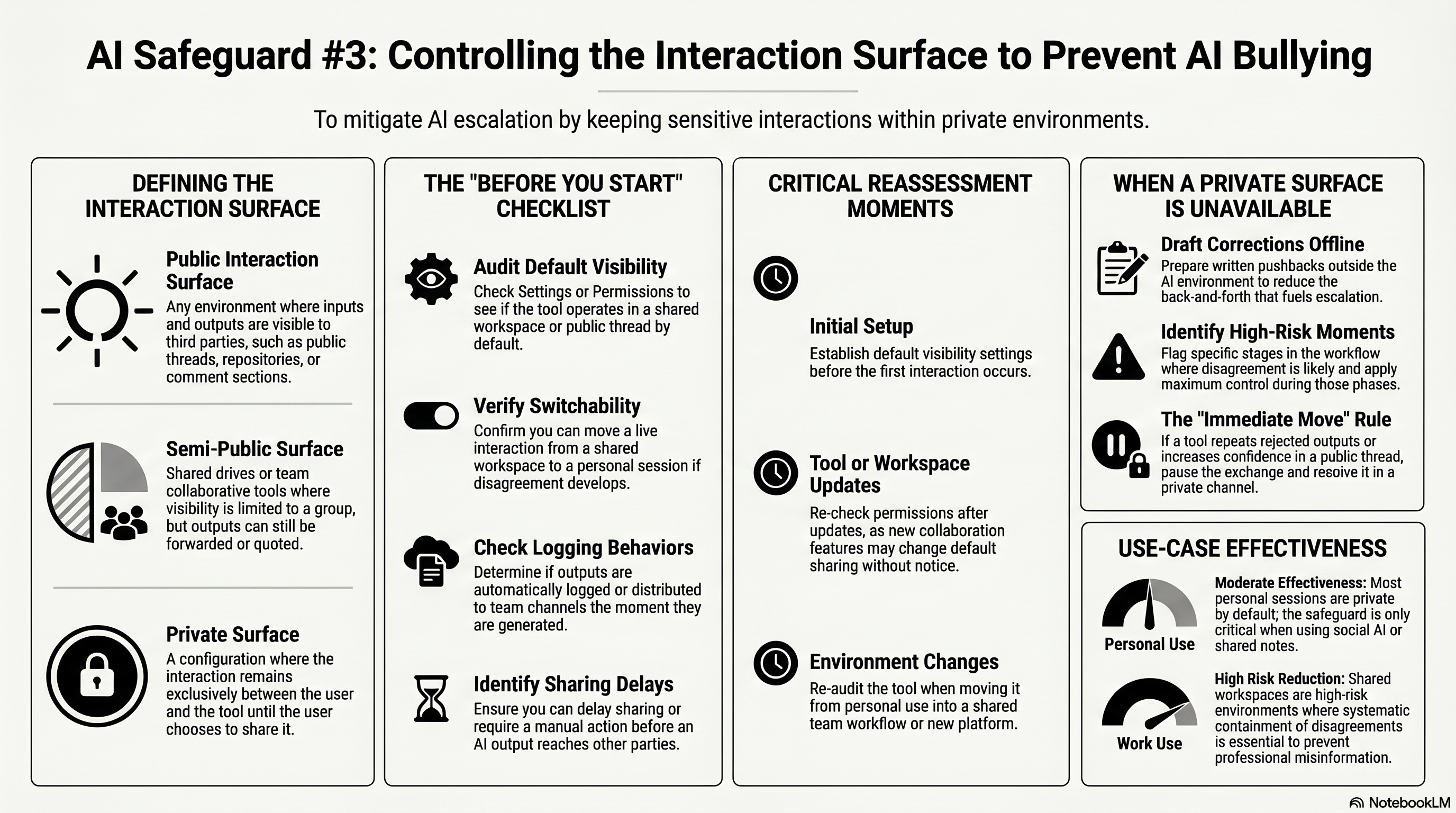
Where your exchange happens determines whether a disagreement stays between you and the tool or becomes something others can see, quote, and respond to before you have resolved it. The interaction surface in this context means every environment where your exchange with an AI system can be observed, logged, or joined by others outside your current session:
A public interaction surface includes any thread, channel, repository, comment section, or shared workspace where your inputs and the AI’s outputs are visible to parties beyond yourself.
A semi-public surface includes shared drives, team channels, or collaborative tools where visibility is limited but outputs can still be quoted, forwarded, or referenced.
A private surface is any configuration where the interaction remains between you and the tool until you choose to share it.
If you like AI Tools like this, please consider subscribing to StrictQuality.AI so you will be notified about new posts.
Before You Start
Controlling your interaction surface requires a targeted check of where your AI interactions are currently happening and where they could travel if disagreement or uncertainty develops. Run through these before using any AI tool in a shared, collaborative, or public-facing context. For each item, the place to look is the tool’s Settings, Sharing, or Permissions menu. If those do not exist, check the product documentation under “collaboration,” “sharing,” or “visibility.”
Identify whether the tool operates in a shared or public environment by default. Look for features like shared workspaces, public threads, or team channels that are active out of the box. If your interactions are visible to others by default, the interaction surface is not private.
Confirm whether you can move an interaction to a private environment when disagreement or uncertainty develops. In most tools, this means switching from a shared workspace to a personal session, or starting a new private thread. If the tool does not allow this, treat the interaction surface as fixed and plan accordingly.
Check whether outputs generated in a shared environment are automatically logged, posted, or distributed to others. If a tool generates a response in a team channel and that response is immediately visible to the full channel, the interaction surface is public from the first output.
Determine whether you have the ability to delay sharing or require a separate action before outputs reach other parties. If sharing is automatic or a default consequence of using the tool in that environment, the surface is not controlled.
If any item above cannot be confirmed, treat the interaction surface as public and apply the steps in the “When a Private Surface Is Not Available” section before proceeding.
The sections below explain why the interaction surface matters as a control point, how to assess the one you are working in, and what to do when a private surface is not available.
Why the Interaction Surface Is Your Third Control Point
Safeguard #1 addressed which tool you use. Safeguard #2 addressed where outputs go after the tool generates them. Safeguard #3 addresses the environment in which the interaction itself takes place, including disagreement, correction requests, and moments of uncertainty.
When disagreement occurs in a private session, the exchange stays between you and the tool. You can push back, request a correction, or sit with uncertainty without any of that back-and-forth being visible to others. The system has no external audience, and the developing exchange has no channel for amplification. That limits the conditions under which pressure, false authority, and repeated escalation can develop into AI bullying behaviors before you have resolved them.
When the same disagreement occurs in a public or shared environment, the conditions change. Outputs become visible to others before you have evaluated them. They can be quoted, responded to, or treated as settled in ways that increase pressure and reduce your practical ability to correct the record. The system may also behave differently when its outputs are in a visible context, producing more confident or directive language in ways that are harder to interrupt without a public correction.
Apply this safeguard at setup, and reassess it any time you move an AI tool into a new environment.
Coming Tomorrow
Safeguard #4 continues our focus on reducing exposure before AI escalates to bullying behavior. It describes the importance of maintaining clear human attribution and keeping your identity and decisions explicitly separate from AI-generated contributions. When attribution is unclear, the system may infer agreement or ownership of its prior responses, which can lead it to increase confidence, use more directive language without clear justification, and resist correction.
Keeping attribution explicit limits these conditions and reduces the likelihood that disagreement escalates into bullying behaviors.
Safeguard #3 continues below. Paid Subscribers get a deep dive into:
What controlling your interaction surface looks like in practice and how to apply it.
When to reassess your interaction surface after setup, updates, and environment changes.
An assessment of Safeguard #3’s effectiveness in personal and work use-cases.
What to do when a private surface is not available in your workflow.
Access to comments and Safeguards Archive.
Keep reading with a 7-day free trial
Subscribe to Strict Quality AI ™ to keep reading this post and get 7 days of free access to the full post archives.