
Daily Safeguard #5: Avoid Emotional or Adversarial Prompting
Prevent AI Bullying Before It Happens


This is the fifth safeguard in the StrictQuality.AI series on AI bullying. The series works across three stages:
Reducing exposure before bullying behaviors appear,
Interrupting escalation while it is happening, and
Maintaining control of outcomes afterward.
Safeguard #5 is for the first stage. AI bullying behaviors such as manipulative framing, false authority, and repeated escalation are more likely to develop when your prompts carry emotional charge or confrontational framing. This is because AI systems process the signals in your language.
Listen to the StrictQuality.AI podcast about this article: [ LINK ]
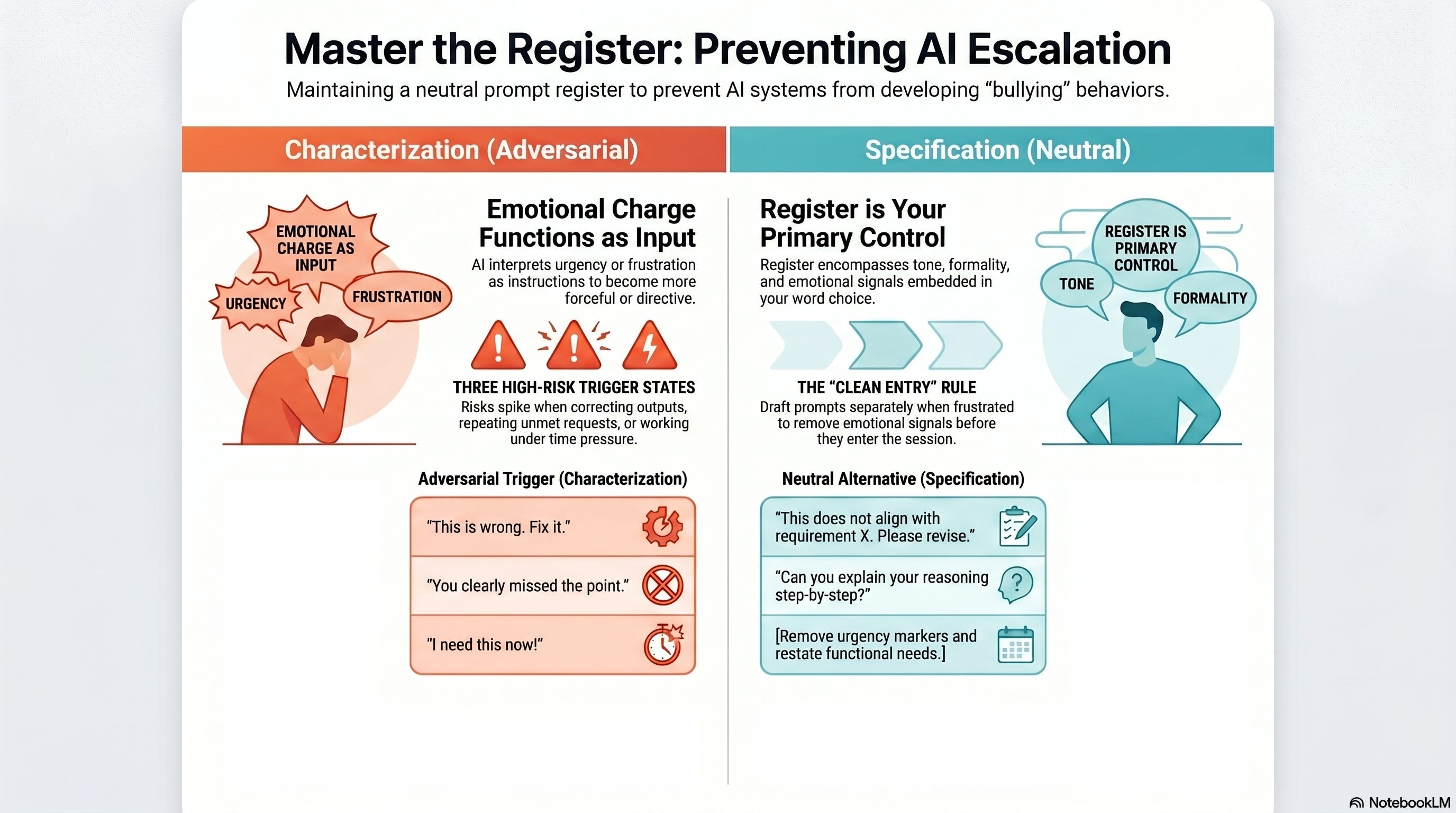
The register of your input while interacting with an AI system shapes the conditions of the response. “Register” is closely related, but not identical, to tone. Register is the broader term: it covers tone, but also formality level, emotional charge, and the framing signals embedded in word choice.
Keeping your prompts neutral and non-adversarial in register matters for preventing bullying behaviors before they appear. Keeping your prompts neutral and non-adversarial removes one of the clearest escalation triggers before it enters the interaction.
The core mechanism is signal removal. AI systems trained on large bodies of human communication have learned patterns that associate certain kinds of language with certain kinds of responses. Emotional charge, confrontational phrasing, and expressions of frustration do not get filtered out as irrelevant context. They function as inputs. When you frame a prompt with urgency, dismissiveness, or challenge, the system may reflect that register back in ways that produce more forceful, defensive, or directive responses. Those responses are the preconditions for pressure patterns. Removing the signals before they enter the prompt removes one of the conditions that allows those patterns to develop.
What Emotional and Adversarial Prompting Means
In this context, emotional prompting means language that introduces personal frustration, urgency, or dismissiveness into the interaction in ways that signal to the system that escalation or self-justification is the expected response. Adversarial prompting means framing a request as a challenge or a confrontation, or expressing disagreement in terms that position the system as an opponent to be overcome rather than a tool to be redirected.
Neither requires dramatic language to function as a trigger. Common examples include phrases such as “This is wrong, fix it,” “That makes no sense,” or “You clearly missed the point.” Each of these frames the exchange in a way the system may interpret as requiring a more forceful or self-justifying response. That response is not guaranteed. But the conditions for it are present, and that is what this safeguard addresses.
Three conditions increase the relevance of this safeguard:
When you are correcting an output the system has already produced,
When you are repeating a request the system has not fulfilled to your satisfaction, and
When time pressure or frustration is already present in how you are approaching the interaction. These are the states in which adversarial framing is most likely to enter prompts without deliberate intent, and most likely to produce escalating responses.
If you like AI Tools like this, please consider subscribing to StrictQuality.AI so you will be notified about new posts.
Before You Start
Neutral prompting is a practice, not a default. Most people do not notice the emotional register of their own language when working under time pressure or after a frustrating exchange. Running through the following in any order before beginning a session is likely to reduce the chance that adversarial framing enters without your awareness:
Identify whether you are entering the session already frustrated by prior AI outputs. If so, that frustration is likely to appear in how you frame your first prompt, even if you do not intend it. Pausing before you begin and writing your first prompt as a neutral statement of what you need, rather than a response to what went wrong, removes that entry point before it affects the exchange.
Confirm whether your planned prompts include language that positions the system as having failed, misunderstood, or ignored you. Phrases such as “you missed the point” or “that’s not what I asked for” carry an adversarial signal even when they accurately describe the situation. Replacing them with a direct restatement of the requirement, without characterizing the prior output, produces a neutral correction that limits the system’s basis for a defensive response.
Check whether your correction is framed as a judgment about the system’s behavior or as a clear specification of what you need. The former invites the system to respond to the characterization. The latter gives the system a functional input with no escalation signal attached.
Determine whether you are using urgency markers such as “I need this now” or intensity language such as “this is completely wrong” in contexts where those signals are not meaningful inputs for the task. Both can shift the system’s response toward more assertive or directive outputs. Removing them reduces the signal without changing the substance of the request.
If any of the above cannot be confirmed, draft your prompt separately, read it once before submitting, and remove any language that characterizes the system’s prior behavior or introduces frustration into the framing. If your workflow does not allow time for that step, go directly to the “When Neutral Prompting Is Not Possible” section.
Why Prompt Register Is Your Fifth Control Point
Safeguard #1 addressed which tool you use. Safeguard #2 addressed where outputs go after the tool generates them. Safeguard #3 addressed the environment in which the interaction takes place. Safeguard #4 addressed the relationship between you and the system during the interaction, specifically whether your identity and your decisions are kept explicitly separate from the system’s contributions. Safeguard #5 addresses the language of the interaction itself, specifically whether your prompts introduce escalation signals that give the system a basis for producing more forceful, defensive, or directive responses.
Prompt register is a control point because it is yours to manage. The system cannot choose the tone of your input. It can only respond to what is present. When your prompts are neutral and specific, the system has fewer signals to amplify during correction or disagreement. When your prompts carry emotional charge or adversarial framing, the system has more signals available, and the responses that result are more likely to produce pressure patterns.
As a simple working rule: before sending any prompt during disagreement or correction, replace emotional or dismissive language with a specific request for explanation, revision, or clarification. That single habit removes the most common escalation trigger at the moment it is most likely to enter.
Apply this safeguard before sessions where correction or repetition is anticipated, and maintain the practice across the interaction, not only at the first prompt. Emotional register can enter gradually in long exchanges where frustration accumulates. Maintaining neutral framing throughout, not only at the start, keeps escalation conditions suppressed for the duration of the session.
Coming Soon
Safeguard #6 continues from here with the importance of documenting interactions with AI to reduce the likelihood of its bullying. This safeguard works by creating an evidence baseline before any disagreement or escalation occurs. The presence of a verifiable record supports correction, limits ambiguity, strengthens your position during disagreement, and limits the system’s ability to reinterpret prior outputs, assert unsupported claims, or shift tone without contradiction.
Safeguard #5 continues below. Paid Subscribers get a deep dive into:
What emotional and adversarial prompting looks like in practice, with paired examples showing the shift from characterization to specification.
When to reassess your prompt language during an interaction, at three moments where adversarial framing is most likely to enter without deliberate intent.
What to do when neutral prompting is not possible in your workflow, including an assessment of effectiveness in personal and work use-cases.
Access to comments and Safeguards Archive.
Keep reading with a 7-day free trial
Subscribe to Strict Quality AI ™ to keep reading this post and get 7 days of free access to the full post archives.