
Identity Fraud Shifts to AI-Enabled Attacks
Trends, Warning Signs, and 12 Practical Tips to Protect Yourself

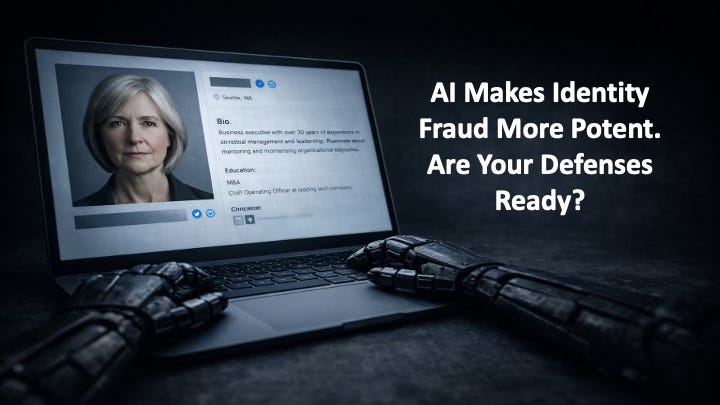
The World Economic Forum (WEF) reports on an analysis of global identity verification data to examine how identity fraud has evolved over the past two years. The analysis shows that identity fraud is changing form from broad, lower-skill fraud activity toward fewer but more coordinated and technically advanced attacks, driven in part by wider access to AI tools.
As AI lowers the cost of producing convincing fake content and automating attack steps, fraud operations become more adaptive, which raises risk across sectors and populations rather than concentrating it in a few high-risk groups.
The analysis points to a 180% year-on-year rise in multi-step fraud attacks in 2025 and reports that AI-assisted document forgery, recorded at 0% the prior year, reached 2% of all fake documents identified.
The WEF story also describes a new generation of AI fraud agents capable of operating across the full attack cycle: fabricating plausible identities from scratch, engaging live with verification systems, and refining their tactics in response to what works, making them significantly harder to detect than static forgery tools.
This changes the fraud problem from one focused mainly on static checks and isolated incidents to one centered on adaptability, coordination, and continuous assessment.
What this means in practice is not obvious. The shift from isolated fraud attempts to coordinated, adaptive attack systems only becomes clear when you see how these attacks operate across multiple steps, how they interact with verification systems, and why traditional defenses are increasingly ineffective.
Because of this evolution in identity fraud technology, governments and companies will need to coordinate more closely, run public awareness campaigns, align identity verification standards, and develop privacy-compatible data-sharing mechanisms to make cross-platform attack patterns visible earlier.
What You Can Do Now
Do not treat video or voice as proof of identity. Verify through a separate, independently initiated channel
Ask how platforms verify your identity, and whether platforms rely only on documents, or use behavioral and real-time verification.
Paid subscribers get:
• A clear explanation of why these attacks are becoming possible and why traditional identity checks are starting to fail.
• A forward view of how the threat is evolving and where risk is increasing.
• 12 practical ways to protect yourself against AI-enabled identity fraud.
Keep reading with a 7-day free trial
Subscribe to Strict Quality AI ™ to keep reading this post and get 7 days of free access to the full post archives.