
Outgunned but Growing: The Organized Resistance to AI
Who They're Up Against, and Why

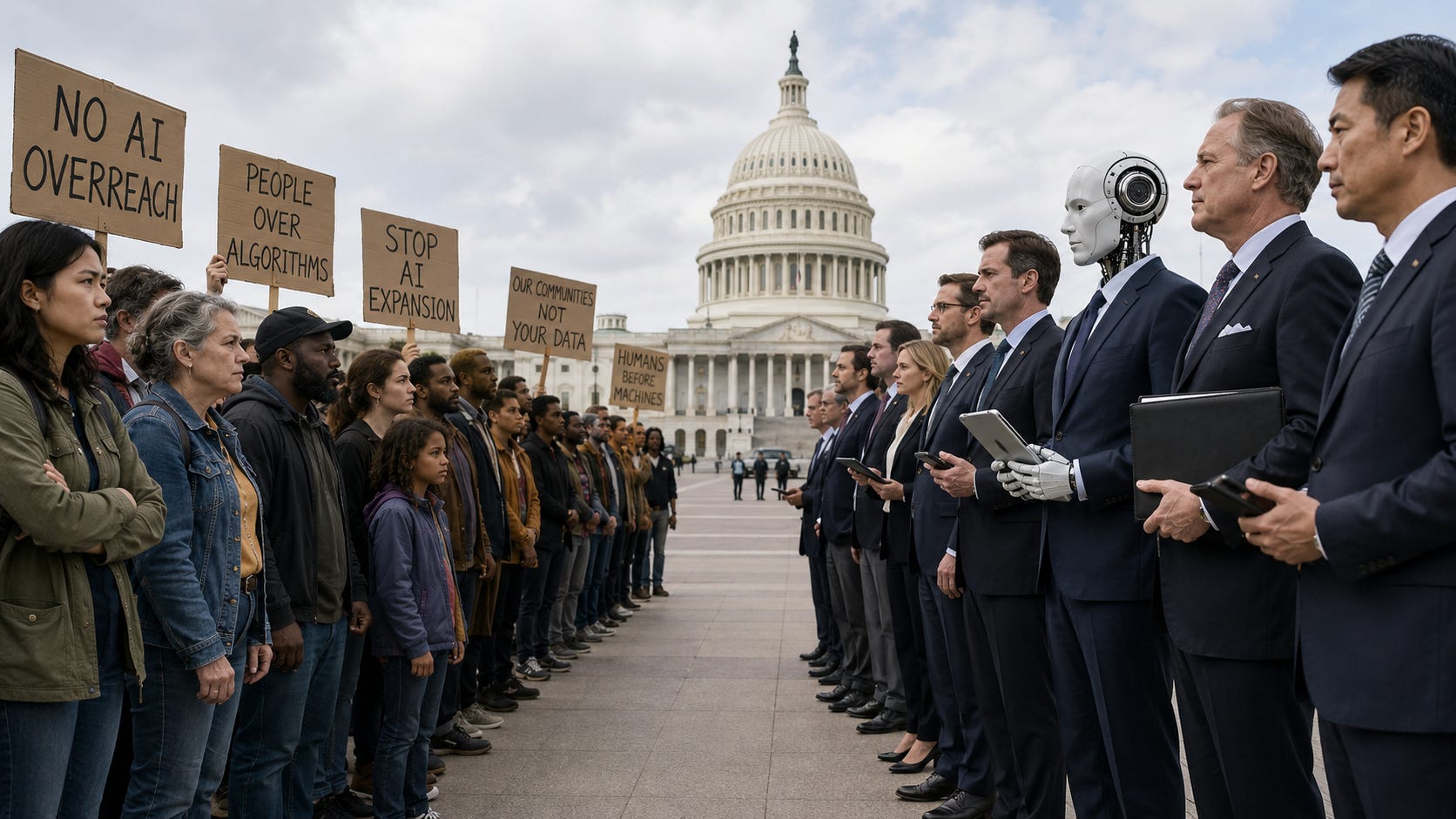
There is a nationwide resistance to the AI boom and the rebellion is growing fast.
Most of the resistance is in local communities affected by data center projects. Data Center Watch, a research firm tracking the resistance, identified hundreds of local opposition groups active in 42 U.S. states at the end of 2025.
According to The National News Desk, communities near proposed data center projects are raising concerns about the load on local energy and water resources, noise, land use, tax incentives, and utility cost increases.
If you like evidence-based reporting like this, please consider subscribing to StrictQuality.AI so you will be notified about new posts.
One local group organized to pushback is The Protect Wake County Coalition, formed to advocate against a proposed data center in North Carolina. It recently announced that the data center project was withdrawn in early 2026 because so many people showed up, spoke out, volunteered, and refused to stay silent.
The Issues of the Resistance
Beyond local fights against data center projects, resistance advocacy has organized around concern for seven core issues:
1. Environment and resources. The physical footprint of AI depends on electricity, water, cooling systems, land, and hardware supply chains. Common resistance tactics include legal objections, moratorium campaigns, public education, and energy-policy pressure.
2. Economic justice, labor, and workforce protection. The core concern is that AI may weaken jobs, wages, entry-level career paths, household affordability, and worker bargaining power. Common resistance tactics include layoff tracking, worker-focused campaigns, utility-cost protests, and economic legislation.
3. Institutional control. The core concern is that AI development is moving faster than law, regulation, safety testing, and public accountability. Common resistance tactics include bills, parliamentary motions, regulatory challenges, court cases, and policy proposals.
4. Existential-risk. This concern focuses on the possibility that advanced AI systems may become uncontrollable or dangerous at civilization scale. Common resistance tactics include pause demands, frontier-AI moratorium campaigns, public statements, safety advocacy, and direct pressure on AI labs.
5. Civil liberties. The core concern is that AI may intensify state power through militarization, policing, surveillance, and data aggregation. Common tactics include anti-contract campaigns, civil-liberties advocacy, digital-neutrality arguments, and public pressure against surveillance partnerships.
6. Children, Education, and Cognitive Development. The core concern is that AI deployment in educational settings is proceeding faster than evidence, democratic deliberation, or parental consent, with unresolved risks to learning quality, student data privacy, academic integrity, cognitive development, and teacher authority.
7. Creative Economy, Intellectual Property, and Cultural Production. The core concern is that AI systems trained on creative work without consent or compensation extract economic value from writers, artists, musicians, journalists, and actors while undermining the cultural institutions that sustain democratic discourse and creative livelihoods.
Each of these issue areas has generated organized advocacy, litigation, legislation, and public pressure campaigns. The groups driving resistance activity span a wide range of organizational types, resources, and tactics. In future articles, StrictQuality.AI will examine each one of the seven issues to better understand the players, the stakes, and the status.
The Struggle for the Future: A New Series from StrictQuality.AI
StrictQuality.AI is starting a series of articles that carefully examine real struggles on the core issues for the future of AI. Each article in the series will focus on one field of contention, profile the resistance and pro-growth actors on the field, what they want, the dynamics of their struggle, and update the current status of their fight.
Coming Next in This Series from StrictQuality.AI
The next article in The Struggle for the Future series launches shortly. It is called “When AI Comes to Town” and it covers the most visible and locally grounded battleground in the entire AI policy conflict: the fight over where AI infrastructure gets built.
Across America, communities are contesting data center projects proposed by some of the largest technology companies in the world. Billions of dollars of construction are being pushed into cities, suburbs, and rural areas that frequently have little warning and less say. Some of those communities are pushing back, and a surprising number are winning.
When AI Comes to Town is a story about power, resources, and who gets to decide the future of AI.
If you like evidence-based reporting like this, please consider subscribing to StrictQuality.AI so you will be notified about new posts.
Paid Subscribers get the full version of this article, including:
A Profile of the Organized AI Resistance.
In the Other Corner: The AI Growth Advocacy Ecosystem.
The Strengths and Weakness of the Resistance Compared to the Ecosystem.
Keep reading with a 7-day free trial
Subscribe to Strict Quality AI ™ to keep reading this post and get 7 days of free access to the full post archives.