
Town Government Wants Data Center, Mother of Six Wants Answers
Tiny Broadview, Montana: future home of one of the world’s largest data centers

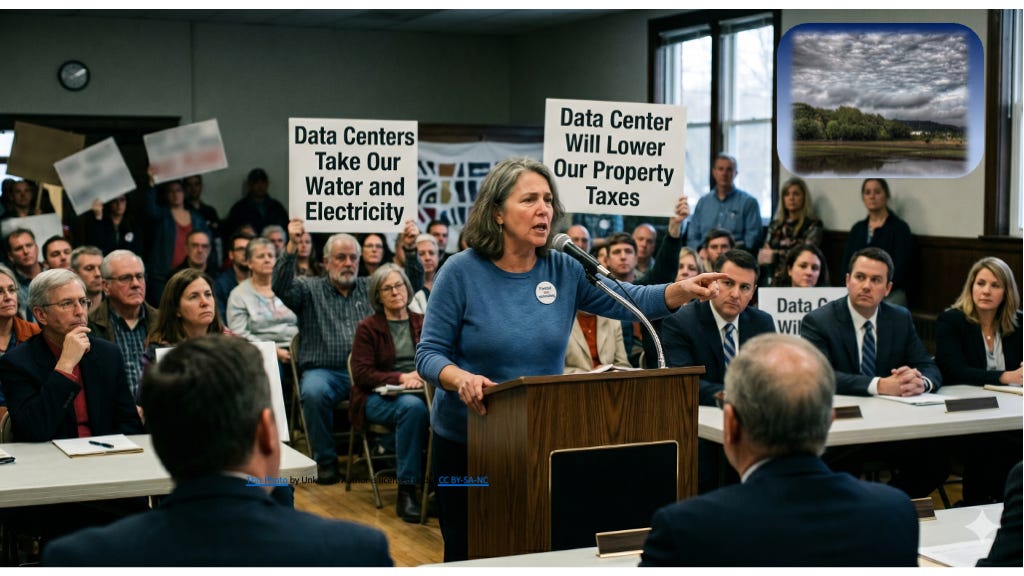
There is an ongoing data center boom across America. It is driven by the enormous AI investments from companies like Nvidia, Microsoft, Alphabet, and Meta, combined with the Trump Administration’s accelerated permitting.
In our last discussion, we went to Nottingham, New Hampshire, where an award-winning entrepreneur withdrew the data center proposal that he submitted to the town government because local citizens and political voices all the way up to the state governor were aligned in opposition.
Now we turn to the proposed Quantica Data Center Project in the small town of Broadview, Montana. Just like we saw in Nottingham, the Quantica Project is causing a conflict between the corporate developer and local residents.
But Broadview is a darker mirror image of Nottingham: local resistance to the Quantica project has faced official silence, procedural barriers, threats of removal from official meetings by law enforcement, and open hostility from some local officials.
But determined women like Cari Olson, Anne Hedges, and Kassi Solberg persist in their search for answers.
In this article, we apply the StrictQuality.AI standards of fairness and evidence-based analysis to understand the dramatic and high-stakes conflict over the proposed Quantica Data Center.
First we describe the massive size of the project. Then we unpack:
The developer’s efforts to win over local support.
The real-world constraints driving local officials and the Broadview Town Council.
The concerns and activities of the opposition.
The dramatic conflicts in Town Council meetings and community forums.
The latest project status.
Takeaway lessons for undecided local residents, data center opponents, local government, and data center developers.
If you like evidence-based reporting like this, please consider subscribing to StrictQuality.AI so you will be notified about new posts.
The Quantica Project
Managed locally by Big Sky Digital Infrastructure, the Quantica data center project was initially planned as a 5,000-acre campus, roughly the size of 3,800 football fields, and expected to consume between 500 and 1,000 megawatts (MW) of power.
In May 2026, local reporting revealed public emails and records showing Quantica Infrastructure filed formal interconnection applications with NorthWestern Energy proposing a maximum additional capacity of up to 7,235 MW across multiple phases. An expansion of this scale would exceed the total electrical capacity of America’s largest power station, the Grand Coulee Dam, and instantly elevate the Montana facility to the upper echelon of worldwide data infrastructure hubs. To ensure exceptionally reliable, continuous, high-quality electricity that data centers need for non-stop operation, the proposal also includes a massive mix of renewable energy, battery storage, and potentially 1,785 MW of natural gas-fired plants.
Sources indicate that Quantica has not yet established a direct connection with a specific tech company to be its client for the proposed Broadview data center. When asked about who will actually use the facility, local Quantica lobbyist Jess Peterson stated that the public will know more “when Quantica signs a contract with a tech company to use the facility”.
As of this writing, much remains unclear about the Quantica project, including:
Final project scale,
Actual customer,
Binding utility cost allocation,
Enforceable water-use limits,
Emissions profile,
Ratepayer exposure, and
Which public bodies have meaningful authority over approval or conditions.
Quantica Builds Local Goodwill
Quantica’s CEO, John Chesser, said, “we’re paying our own way for power, without increasing Montanans’ electricity bills for our project. We’ll pay the cost of electricity infrastructure and any new power generation needed to serve our project”.
Quantica’s Chief Financial Officer Charlie Baker, a Billings resident with 20 years in the Montana power industry, has publicly promised that Quantica will pay for the massive electrical grid upgrades required for the 7,235 MW expansion. He also said that, depending on the customer and infrastructure availability, the data center would use a closed loop cooling system to reduce water impacts on the community.
Meanwhile, Peterson claims the project will be “a data center done right” with minimal land and water impact, promising permanent, good-paying jobs for security guards, janitors, and maintenance workers.
To build goodwill in Broadview, Quantica’s activities include:
Holding weekly office hours inside a newly renovated garage belonging to a town council member.
Funding school sports concessions.
Buying livestock from the local 4-H club.
Flipping burgers at the community’s summer festival.
Suggesting a “community benefits package,” which could help Broadview pay for things like its problematic wastewater lagoon.
Despite these activities and assurances from corporate executives, environmental advocates are urging the town to adopt policies to protect local families and small businesses from the data center impacts.
The Town
Broadview, Montana is a very small town, roughly 130 acres and a population of around 140 people. Its wastewater lagoon is failing; partnering with a wealthy developer may appear to town officials to be one of the few realistic ways to secure the potentially millions of dollars of critical infrastructure funding that the town could otherwise not afford.
Broadview has zoning power over land within the town and the volunteer Town Council has authority to decide special use and zone-change applications. However, the proposed data center site lies beyond municipal boundaries, and council members have argued that they have no authority over whether the project can proceed.
According to the New York Times, Mayor Roger Swartz said the council “was not legally obliged to answer the public’s questions about the project”.
The central question remains: even if Broadview lacks formal authority over the data center site itself, what responsibility does the town have to answer residents’ questions about a massive project close enough to affect town infrastructure, residents, politics, and public trust?
The Opposition’s Concerns
Broadview area resident Cari Olson said she’s concerned about water use, noise, and tax incentives for large tech companies.
Environmental advocacy groups warn the facility will require immense amounts of water for cooling and could force local utilities to rely on aging fossil fuel infrastructure. They also have concerns that these massive utility upgrades will cause public health issues and energy bills to skyrocket for everyday Montana ratepayers (Link 1, Link 2). These groups are pushing for regulation and protective policies, such as:
Transparency measures that require developers to disclose their actual resource usage and emissions.
Separate utility rate classes to ensure data centers pay for grid expansions without subsidizing costs onto local families and small businesses.
However, Quantica lobbyist Peterson asserts that much of the local apprehension stems from a “general fear of artificial intelligence”.
The Resistance Begins But Residents are Divided
The local resistance began on January 4, 2026, when Cari Olson started hosting events to alert the community to the data center developments and local residents saw a Facebook video. This sparked a public forum at Rocky Mountain College, attended by a packed crowd of over 100. The venue quickly filled to capacity, forcing an overflow crowd to gather out in the corridor just to catch what the speakers were saying.
Hosted by the Montana Environmental Information Center, the forum’s goal was to educate locals on the massive utility demands and resource footprints associated with the recent wave of data center developments in Montana.
Anne Hedges, the Executive Director of the Montana Environmental Information Center, helped host the forum. She commented on the intense community pushback against the developments, stating, “People are very upset. We are seeing a response that, in my 32 years, I’ve never seen”. Hedges displayed a letter of intent from NorthWestern Energy, the power provider, regarding the Quantica project. While presenting the heavily censored letter, she highlighted the lack of transparency by telling the audience that about the only thing not redacted “is the language that says, ‘This is confidential’”.
Clint McCulloch, the president of the Southeast Montana Building Trades Council, was in the audience and he was in favor of the Quantica project, saying “There is a workforce right here in Yellowstone County and Montana that can work and build that facility.”
Also in the audience was Kassi Solberg, a 43-year-old mother of six who, with her family, had just moved near the proposed site. Solberg sat taking detailed notes, learning for the first time about the staggering water and electricity requirements needed to cool and power the massive data servers.
Quantica executives were sitting near Solberg; chief financial officer Charlie Baker and local lobbyist Jess Peterson were only a short distance down the same row. Baker and Peterson, according to reports, silently listened.
Solberg noticed the Quantica company logo emblazoned on Baker’s jacket.
Kassi Solberg became a driver of the opposition to the data center. Saying “I’m just trying to warn everyone about it,” she consistently attended Broadview town council and Yellowstone County Commission meetings to demand transparency, accountability, and a temporary halt to the development. She explained, “I hope I will be able to make a difference”.
However, she was met with legal paralysis, defensiveness, confrontation, and active hostility.
The Confrontation
When Solberg attended Broadview Town Council meetings to demand information and transparency about the data center project, Council members refused to answer her, citing non-disclosure practices and a lack of local jurisdiction.
Mayor Roger Swartz flatly refused to answer her questions, declaring that the town’s lawyer said the council “was not legally obliged to answer the public’s questions about the project”. Mr. Swartz also rejected Solberg’s appeal for a community-wide information session on the project because the land lies beyond municipal boundaries. When Solberg continued to push for transparency, Mayor Swartz warned that he would have the sheriff remove her.
During the meeting, an incensed council member stood up abruptly, mere inches from Solberg’s face, and ordered her to exit. Solberg was also informed by a council member, the sister of Mayor Swartz, “You can’t stop it”, referring to the Quantica data center.
Environmental Stakes Escalate Dramatically
Seeking time for the community to study the proposed data center’s massive environmental impacts, Solberg petitioned the Yellowstone County Commissioners for an emergency interim zoning ordinance to temporarily freeze development.
In March 2026, the commissioners officially struck down her request. Instead, they handed her an impossible bureaucratic escape hatch, suggesting she pursue a citizen-led special zoning ordinance. A special zoning ordinance is a citizen-initiated zoning area designed to protect the health, safety, and welfare of county residents. This mechanism shifts the entire multi-million-dollar burden of regulatory drafting onto an untrained citizen.
Solberg is now the primary grassroots organizer leading the effort for this alternate route, which shifts the burden onto her to independently formulate the zoning regulations and obtain signatures from a minimum of 60 percent of the property owners with parcels adjacent to the proposed facility. Despite lacking formal training in the law, she frequently works well into the early morning hours to piece together these technical regulatory documents by herself. To evaluate the evolving zoning drafts and secure the required signed authorizations for the ordinance, Solberg organizes digital meetings every week for the 20 adjacent property holders.
Solberg says, “I started petitions in all four counties that make up Broadview because of this … we don’t know where they’re going”. The petition for the special zoning ordinance has faced significant hurdles, including apathy from local residents. However, Solberg is supported by residents whose livelihoods depend on local resources, such as Tim Wipf, president of a local Hutterite farming colony near Broadview, and Rick Eaton, a local knife maker and horse rancher. Mr. Wipf has formally appealed to county commissioners out of concern that the facility would deplete their shared agricultural aquifer. He expressed frustration with the attitude of the developers, saying, “These people do think we are stupid”. Mr. Eaton attended a Yellowstone County hearing to formally support Kassi Solberg’s request for an interim zoning ordinance to pause the data center development.
Upcoming Events
There is another Town Hall meeting scheduled for June 18, 2026 at the Broadview Community Center. A community panel has been organized to discuss what the massive AI facility means for Yellowstone County.
Concluding Takeaways
The Quantica dispute is a case study in what happens when a project with national-scale energy implications enters a small community whose institutions were not built for that level of technical, financial, and political pressure.
Data center projects in other communities will have their own unique circumstances. What is right for those towns might not be the same as for Broadview. Nevertheless, Broadview’s conflict shows four things that may be similar across venues:
Residents should have a right to ask for and get clear answers before a project of this scale becomes irreversible.
Local officials may be trying to solve real infrastructure problems with very limited tools.
Developers should work to earn local goodwill and trust, particularly when the core facts about power, water, customers, costs, and legal accountability remain unclear to the public.
Data center opponents need passion, credible evidence, and legal pathways that do not collapse under administrative burdens.
In addition to these four general observations, StrictQuality.AI suggests specific takeaways for undecided residents, data center opponents, local government, and data center developers.
For Undecided Residents
If you are a resident who does not know what to think yet, that uncertainty is reasonable. A project this large should not be reduced to either “jobs and investment” or “corporate threat.” The right first step is to separate confirmed facts from promises, assumptions, and fears.
Residents should ask basic, concrete questions.:
How much electricity will the project require at each phase?
Who pays for transmission, generation, and grid upgrades?
What water will be used, from what source, and under what limits?
What happens if the project expands?
What company will ultimately use the data center, and what does that customer’s expected workload imply for the project’s scale, power demand, water use, and future expansion?
What agreements are confidential, and why?
Which local, county, state, and utility regulators actually have authority?
These are the minimum questions any community should ask before accepting a project that could permanently change land use, infrastructure, public finance, and local trust.
For Data Center Opponents
The Broadview opposition has already shown the importance of early public attention. One resident’s Facebook video helped move the project from obscurity into public debate. That matters. Large infrastructure proposals often proceed most quickly when ordinary residents do not yet understand what is being planned.
But opposition also has to become more than alarm. The strongest resistance is evidence-based, specific, and procedurally disciplined. That means documenting claims, identifying the correct decision-makers, requesting records, showing up consistently, and translating public concern into lawful mechanisms that government bodies must address.
Opponents should also be careful not to overstate what is known. If the evidence shows uncertainty, say uncertainty. If the concern is potential cost shifting, water depletion, emissions, or lack of transparency, name the concern precisely.
Credibility is one of the most important assets residents have when facing a developer who has money, lawyers, lobbyists, and access.
For Local Government
Local government officials in small towns are often placed in an impossible position. They are expected to evaluate projects with massive technical complexity while working with limited staff, limited budgets, and limited legal capacity.
But limited resources do not excuse poor public process. Silence, defensiveness, threats, and hostility are governance failures when residents are asking basic questions about a project that could reshape their community. Even when officials believe they lack jurisdiction, they still have a responsibility to explain what they know, what they do not know, what they are legally allowed to say, and which public bodies do have authority.
The Broadview case points to a practical lesson for governmental institutions in other communities: do not wait until the developer arrives. Towns and counties should establish data center review standards before a specific project creates pressure. Those standards should address disclosure, utility cost allocation, water use, emergency services, land-use compatibility, tax impacts, public meetings, conflict-of-interest rules, and conditions for expansion.
For Data Center Developers
Developers should take the Broadview conflict seriously. Office hours, school concessions, livestock purchases, or offers to help fund wastewater repairs are useful gestures, and the office hours may have provided some residents with answers. But they do not resolve the larger public-record problem if key facts about project scale, utility impacts, water demand, emissions, land use, customer identity, and financial responsibility remain unclear or unenforceable.
The most important question for developers is whether they can build public legitimacy before distrust hardens. Once residents conclude that information is being withheld, that local officials are aligned against them, or that the project is already inevitable, the developer is managing a legitimacy crisis as well as a permitting process.
A data center “done right” requires clear disclosures, enforceable commitments, independent verification, and a public process that treats skeptical residents as stakeholders rather than obstacles.
The Broader Lesson
The AI economy may be global, but its infrastructure footprint is local. When a data center lands in a small town, residents often are asked to bear the consequences without enough information, legal authority, resources, and voice to decide what kind of future they are being asked to accept. In hundreds of communities across the country, people are saying this is not acceptable and they are organizing in opposition.
The Broadview dispute highlights challenges for people and institutions trying to manage the personal, environmental, institutional, economic, social, and systemic impacts of advanced AI. How will the risks, costs, and benefits be distributed?
There are at least two distinct but complementary approaches that are clearly articulated by two nonprofits doing excellent work on our future life in the Age of AI.
In the words of nonprofit Windfall Trust,
“Down one path lies extreme inequality — untold prosperity flowing to the hands of the few, while many lose their livelihoods, dignity and bargaining power.
Down the other path lies a profound opportunity — the chance to design an economy where everyone can thrive”.
As the nonprofit Future of Life Institute (FLI) puts it:
“If properly managed, these technologies could transform the world in a way that makes life substantially better, both for the people alive today and for all the people who have yet to be born. They could be used to treat and eradicate diseases, strengthen democratic processes, and transform education.
If improperly managed, they could do the opposite. They could produce catastrophic events that bring humanity to its knees, perhaps even pushing us to the brink of extinction.”
I hope you will consider where you stand on the questions they are raising, and think about the decisions that will shape your role in how our future develops.
If you like evidence-based reporting like this, please consider subscribing to StrictQuality.AI so you will be notified about new posts.