
Transform Your Career for Success in the Age of AI
Elite career coaches teach how to go from obsolete to indispensable


I keep hearing about job layoffs caused by AI. Even though there is some debate about how much of it is really caused by AI, it is unsettling for those of us who want to keep our jobs or even get ahead in our careers.
Many mid- and senior-level managers who either are not using AI or lack fluency in it have career anxiety, afraid their job is heading for obsolescence. Why?
Probably because they see junior staff using AI to fast-track months of on-the-job experience, allowing them to rapidly perform at the level of senior staff not using AI tools. [ LINK ]
The instinctive response is to work harder, longer, and smarter. But career coach Caroline Castrillon draws a direct line between that instinct and increasing career risk: professionals who attempt to compete with AI on raw output speed are engaged in a losing race.
StrictQuality.AI has crafted a Career Transformation Strategy to support managers who feel vulnerable because their value proposition is defined around output volume and coordination rather than AI-era judgment, orchestration, governance, and accountability.
The goal is to make your job description, resume, and professional network more credible for the expanding class of AI-adjacent management roles, including possible pathways toward positions such as Director of AI Quality Assurance & Risk Governance. These are roles where experienced human judgment, operational accountability, workflow oversight, risk governance, and fluency with human-AI systems matter.
As Neha Kabra (McKinsey Partner and Substack publisher helping leaders think about AI, technology, leadership, and execution), writes, “Asking AI what to do does not make you an expert. Knowing how to direct it does”. [ LINK ]
The Career Transformation Strategy is a programmatic, practical, action-oriented way to make this career transition even if you are starting with almost no AI fluency now. It is a system that:
Draws on the published methods, tools, and tips of four elite career coaches who have each developed explicit frameworks for AI adaptation and professional protection.
Leverages the organizational need to govern AI-assisted junior staff and AI agents generating output at scale.
Transforms the skills and professional identity of experienced managers who have weak fluency in AI, but strengths in business models, organizational governance, risk management, and professional accountability.
In short, the Career Strategy transforms a legacy white-collar manager into an indispensable one for the AI Age.
This article, the first of a five-part series, is an Executive Summary of the complete strategy.
If you want more evidence-based reporting like this, please subscribe to StrictQuality.AI so you will be notified when new articles and podcasts are posted.
Introduction to the Four Career Coaches
Sandra Buatti-Ramos builds learning ecosystems specifically designed to prepare job seekers and working professionals for an AI-disrupted workforce. Her staged career development model mapping self-reflection through prototyping and testing is central to the coaching architecture in this series. Her professional background and institutional work are documented on Forbes Councils. [ LINK ]
Caroline Castrillon, who we mentioned earlier, advises professionals on how to protect their roles from automated displacement by pairing AI tools with experienced human judgment rather than attempting to compete with AI directly. Her full column archive is available via Muck Rack.
Kyle Elliott coaches tech and corporate professionals on how to intentionally integrate large language models into career development without sacrificing personal edge or professional distinctiveness. His analytical framework for evaluating AI as a career tool has been published on Forbes. [ LINK ]
Elliott’s step-by-step guidance on the specific behaviors that accelerate job displacement and detailed tactical protection guardrails also have been published there [ LINK ]
Michelle Perchuk developed the M.A.D. framework -- Modify, Amplify, Dominate -- a three-step process designed to help professionals future-proof their livelihoods in an AI-accelerated environment. Her full strategy guide is available on Forbes. [ LINK ]
StrictQuality.AI has blended their open-source frameworks into a single, cohesive Career Transformation Strategy without losing the distinct professional credit belonging to each coach.
The Strategy is Like a Car
I think of the strategy as if it were a car with a Dashboard and an Engine for you to drive toward your career destination.
The Dashboard charts your trajectory across four distinct phases. Each phase carries milestones designed to move you toward high-judgment roles that AI is not positioned to replace.
The Engine operates as a set of recurring weekly action protocols organized into three tracks:
Track 1: Financial Cushion Management.
Track 2: Skill Evolution. and
Track 3 Relational Network Activation.
These tracks convert your long-term repositioning goals into specific, manageable, weekly habits built on routines, coaching tools, prompting frameworks, and networking scripts.
Overview of the Career Transformation Strategy
The Strategy is a process with four phases and three parallel tracks. Each phase integrates a core strategic objective, the weekly Engine Tracks that support it, and the specific coaching frameworks driving it.
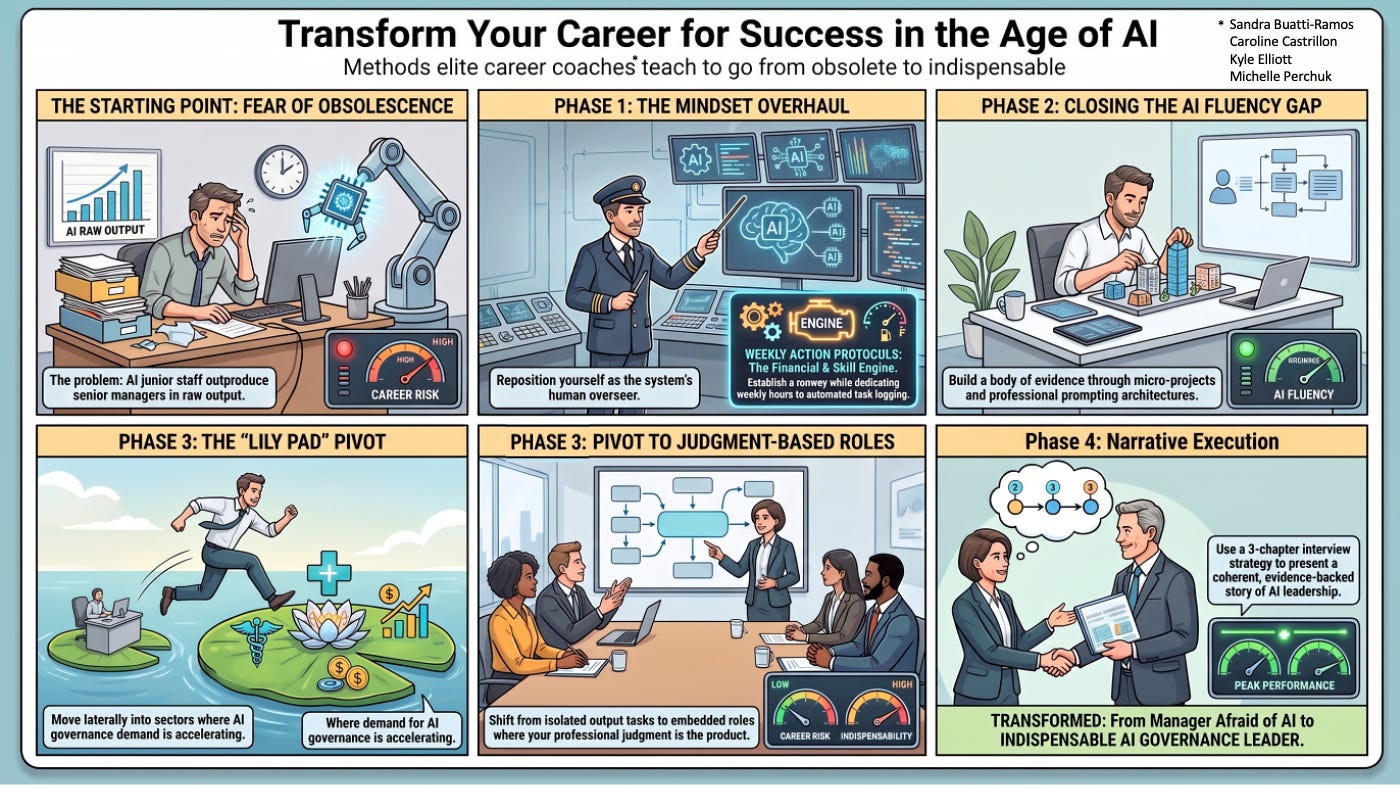
Phase 1: Mindset Overhaul (Week 1)
The first phase is the most foundational and urgent. The objective is a single cognitive shift, a structural repositioning of how you define your professional identity.
During Phase 1, Engine Tracks 1 and 2 are active: financial check-ins establish the runway that makes it feasible for you to take some career risks, while you automate a log of tasks where AI is already operating in your workflow.
On the coaching side, Buatti-Ramos’ Self-Reflection and Professional Identity Definition methodologies anchor the internal work; Elliott’s “Six Behaviors to Avoid” provides a concrete behavioral boundary for what not to do.
The governing metaphor -- treating AI as an administrative assistant rather than a competitor -- is drawn from Castrillon and Perchuk.
The outcome at the end of Phase 1 is that you have a documented identity shift: a written professional definition that positions you as the system’s overseer rather than its competitor, and a working log of which weekly tasks AI has already absorbed. This is the evidence base that every later phase builds on.
Phase 2: AI Fluency Acquisition (Month 1)
The second phase addresses a gap that shows up differently depending on where you sit in your career, but still shows up for nearly everyone: a thin public track record in AI-augmented work. This often means you are competing against entry-level hires who came up using AI tools natively, or against younger peers who have logged more visible AI-augmented projects. The objective in either case is the same: close that gap independently, on your own timeline, without waiting for an employer to provide the opportunity.
Tracks 1 and 2 remain active: the cash runway continues, and upskilling hours become a fixed weekly commitment. The core tools for this phase are Elliott’s AI Prompting Architecture, which structures how to interact with large language models at a professional level, and the Job Description Recipe Spreadsheet, which maps your existing workload against the AI-augmented role definitions employers are now writing.
Buatti-Ramos’ Career Prototyping and Testing approach provides the mindset that makes the skill acquisition stick.
By the end of Phase 2, you have a concrete body of evidence:
A set of completed micro-projects built through hands-on prototyping,
A workload map showing exactly where your current role overlaps with AI-augmented job descriptions, and
A working fluency with the prompting techniques that hiring managers now expect from experienced candidates.
Phase 3: Repositioning and Networking (Months 6 through 12)
The third phase moves from internal preparation to external positioning. Its objective is structural: leave behind isolated, output-driven roles and move into embedded roles where your judgment is the product, not your output volume.
For a mid-level engineer or manager, this often means moving out of a narrow technical lane into a role with broader scope. For a senior-level, it often means moving out of a deep specialization into a role with cross-functional authority. Both moves run through the same mechanisms of Tracks 2 and 3:
Project volunteering expands your visible portfolio into AI-adjacent domains, while continuous industry connection-building establishes professional relationships that embedded roles require.
Buatti-Ramos’ Career Scenarios Exploration framework guides evaluation of pathways that are genuinely AI-resilient versus which only appear to be.
The strategic concept of “Lily Pad Pivots” -- moving laterally into sectors like banking, healthcare, pharmaceuticals, and manufacturing, where AI governance demand is accelerating -- is operationalized through Elliott’s LinkedIn Target Research framework, alongside Perchuk’s 80/20 Networking Rule and ‘Professional Mirrors’ approach to relationship-building, both internal and external.
By the end of Phase 3, in addition to plans that you can act on with confidence, you have a live network of cross-industry contacts and an internal sponsor who can advocate for your move into an embedded, judgment-based role.
Phase 4: Narrative Execution (Month 18 and beyond)
The fourth phase is where your transformation becomes visible to the market. Your objective is to secure high-value roles in expanding sectors by presenting a coherent, evidence-backed professional narrative.
Buatti-Ramos’ concept of High-Level AI Orchestration provides the intellectual framework for how you describe your role in relation to the systems you govern.
Your core tool in this phase is the 3-Chapter Interview Strategy, developed by Perchuk, weaving in Elliott’s Leadership Guardrails and Buatti-Ramos’ AI Orchestration thesis.
By the end of Phase 4, you have a rehearsed, structurally sound interview narrative that opens, develops, and closes with deliberate pacing; and you are ready to be offered a role such as Director of AI Quality Assurance & Risk Governance.
The Key Takeaway
The Career Transformation Strategy is for managers with vulnerable careers because their value proposition is still defined around output coordination rather than AI-era orchestration, judgment, governance, and accountability. The Dashboard, Engine, and four-phase architecture together are a coherent, programmatic process for transforming those weaknesses into valuable strengths for career growth and success.
What Comes Next in This Series
Article 2 publishes next. It covers Phase 1 in full: the exact weekly routines, the behavioral boundaries, and the identity work that move this strategy from concept to action.
If the career transformation described above is the direction you want your career heading in, signup for a free or paid StrictQuality.AI subscription so that Article 2 will be delivered to your inbox the moment it publishes.
Article 3 will cover Phase 2 “Erasing the Track Record Deficit”; Article 4: Phase 3 “The Pivot to Embedded Roles and Relational Networks”; and Article 5: Phase 4 “Narrative Execution and the Conclusion”.