
We Loved Them. They Died. Then We Had Dinner with Their Echo
Should You Build a Loved One's Echo in AI? What to Know First.

I’ve been thinking lately that AI, with its built-in synthetic empathy and emotional persuasion, has the potential to so capture our time, attention, and emotional bandwidth that we become deprived of a life filled with human warmth and connection.
But then Sienna, in her Substack post about a single mother in a year-long relationship with an AI, asked “If I experience something as emotionally real, does it matter what’s on the other side?”.
Emotion-rich Human-AI relationships have been in the popular culture for quite a while. For example, while watching the Amazon show Scarpetta, I saw one character very engaged in a GenAI relationship with her deceased spouse.
In the real-world, Amy Kurzweil built a chatbot of her deceased grandfather. In 2018, four years before the release of ChatGPT, she used his writings to construct a system that could answer questions in his voice. The result felt intimate at times, incomplete at others.
The underlying technology has advanced considerably since then. Today, you can build something far more convincing and far more complicated. I call it the Loved One’s Echo in AI.
Two Key Ideas to Help You Get Started
These are worth thinking about before you build your Echo:
The question that changes everything: Are you prepared to treat the Echo as an interpretation of your loved one, not as their voice speaking from beyond? It’s an easy distinction to agree with in the abstract, and harder to hold onto in the moment, especially when the Echo sounds right and says something you really wanted to hear.
The design reality most people miss: A Loved One’s Echo in AI is more than a voice clone with good responses to your prompts. It is a layered system with six distinct parts: a persona data layer, a persona specification, an orchestration layer, a monitoring layer, a governance layer, and relationship modeling.
When you are comfortable with the idea of an Echo in AI and you see the full picture from start to finish, the project feels less like a tech experiment and more like a way of keeping your loved one close.
Alive in Our Hearts, and More
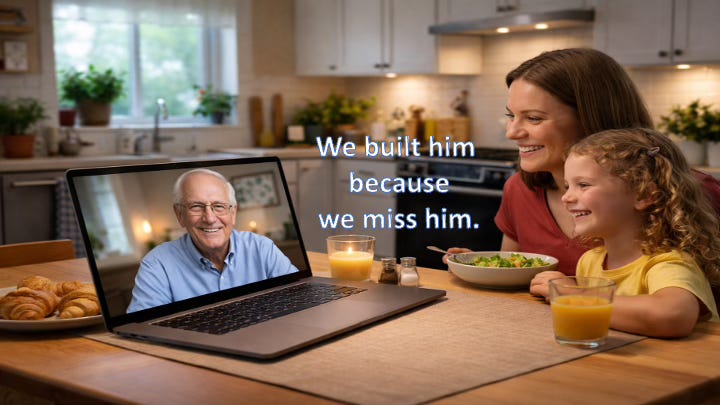
Picture opening a display screen and seeing your grandfather looking back at you. He speaks in something close to his own voice. He responds in a style shaped by his letters, his old emails, the expressions he always used, the way he told a story, the way he handled disagreement.
Now expand the screen. Your grandmother is there. An uncle. A great-aunt. A sibling who died too young.
You ask: “Grandma, my oldest is 19 and thinking about moving away for a job. I’m conflicted. What did you think when Dad did the same thing?”
This is no longer science fiction in the simple sense. The component parts already exist. A large language model can be conditioned on a person’s written and digital history of photos, video clips, voicemails, family stories, social media archives. A voice model can clone a voice from recordings. An avatar layer can animate a face. A control layer manages the conversation and injects evidence.
What you’d have is a Family Echo in AI, a layered system trained on the available fragments of your loved ones’ lives that produces evidence-conditioned, style-constrained simulations of your family members now gone who once existed as vital parts of our lives.
Keep reading this article if you’re asking:
Is a Family Echo in AI system right for me and my family?
How do I build one, technically and legally?
What should I realistically expect?
What should I watch out for?
Paid subscribers get:
A self-assessment to get deeper and more nuanced insight into whether building and engaging with your Loved One’s Echo in AI is right for you.
A step-by-step guide to build an AI emulation of your deceased family member that echoes how they looked, sounded, and might have responded if they could be with you now.
Recommendations on how to handle the echo of difficult relatives.
Keep reading with a 7-day free trial
Subscribe to Strict Quality AI ™ to keep reading this post and get 7 days of free access to the full post archives.