
We're Standing Unprepared at the Crossroads
Two Nonprofits to Watch for a Better Future with Transformative AI

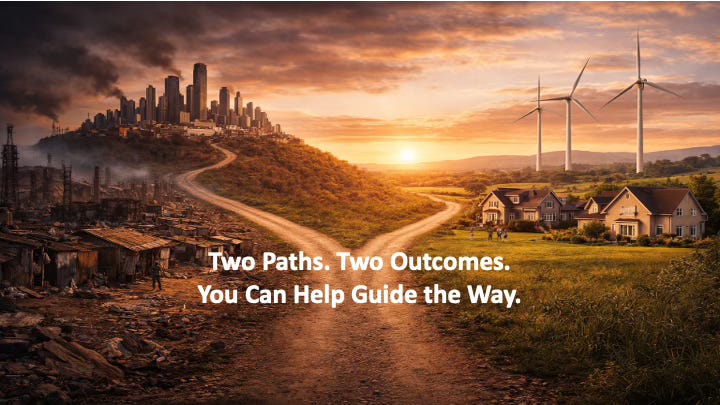
Windfall Trust and Future of Life Institute are two nonprofit organizations doing forward-looking work on the economic and safety implications of AI that will soon be transforming economies and labor at scale.
These organizations represent two distinct but complementary approaches to the same problem: how to manage the economic and systemic impacts of advanced AI.
Below are brief summaries I pasted directly from their own materials with only minor edits, with links for readers who want to examine their work in detail.
Windfall Trust from their website
What happens when AI creates vast wealth but leaves billions of people behind?
Advanced AI could upend the economy — generating enormous wealth, creating a drop in the value of human labor, and triggering economic shocks that reach all corners of the globe.
Our systems of work, welfare and governance are critically unprepared.
We stand at a crossroads.
Down one path lies extreme inequality — untold prosperity flowing to the hands of the few, while many lose their livelihoods, dignity and bargaining power.
Down the other path lies a profound opportunity — the chance to design an economy where everyone can thrive.
Windfall Trust is bringing together tech pioneers, economists, and policymakers to plan for a future where no one is left behind.
We are a network of independent researchers, innovators, communicators and strategists, working to prepare society for the economic disruption that transformative AI will bring, and to shape a future where the windfall that it generates benefits all of humanity.
We are dedicated to creating a world where the economic windfall generated by transformative AI is shared equitably.
This is our chance to create the kind of world we all want to live in.
Future of Life Institute (FLI) from their website
FLI publishes the AI Safety Index (Winter 2025 Edition), a report card that rates leading AI companies on key safety and security domains.
The Institute’s goal is to steer transformative technology towards benefiting life and away from extreme large-scale risks. Their online content includes articles, newsletters, podcasts, and open letters.
The FLI Mission: Preserving the future of life.
How certain technologies are developed and used has far-reaching consequences for all life on earth. This is currently the case for artificial intelligence, biotechnologies and nuclear technology.
If properly managed, these technologies could transform the world in a way that makes life substantially better, both for the people alive today and for all the people who have yet to be born. They could be used to treat and eradicate diseases, strengthen democratic processes, and transform education.
If improperly managed, they could do the opposite. They could produce catastrophic events that bring humanity to its knees, perhaps even pushing us to the brink of extinction.
Bottom Line from StrictQuality.AI
Windfall Trust focuses on ensuring that AI-generated wealth reaches beyond a narrow few, while the Future of Life Institute focuses on risk and safety governance.
Taken together, these two organizations go deep into the territory that most AI policy conversations skip past.
By tracking Windfall Trust’s work on economic equity alongside the Future of Life Institute’s work on safety governance, readers gain a balanced framework for the two most urgent questions of the AI transition: Who benefits, and how are risks controlled?
I hope you will review their materials directly to form your own view of their work, consider where you stand on the questions they’re raising, and draw implications for the decisions that will shape your role in how AI develops.